
ANZUP at ESMO 2025 – TheraP
TheraP
Background
Prostate cancer remains the most commonly diagnosed cancer in Australia and New Zealand with over 28,000 cases expected to be recorded in 2025¹,². Thanks to world class research, prostate cancer can be treated effectively for the majority of the people affected. Nevertheless, over 4,000 people every year will die due to an advanced or hard-to-treat form of prostate cancer and many more people will have life-long treatment related side-effects including morbidity associated with long-term hormonal suppression, sexual dysfunction and mental health issues³.
Metastatic castration-resistant prostate cancer (mCRPC) is a type of advanced prostate cancer that has spread to other parts of the body and no longer responds to standard hormone therapy, which is meant to lower testosterone. Even though testosterone levels are low, the cancer keeps growing. While it can’t be cured, there are several treatment options that can help slow the cancer down and manage symptoms.
About the trial
Lutetium-177 PSMA radionuclide therapy (Lu-PSMA) is a new treatment for advanced prostate cancer. Lu-PSMA is a radioactive molecule that specifically attaches to cells with high amounts of PSMA on the surface of the cells. This allows the radioactivity to be delivered mainly to the prostate cancer cells wherever they have spread, while sparing most normal tissues. Previous small studies of Lu-PSMA showed promising activity in patients with advanced prostate cancer.
This randomised study has compared Lu-PSMA, with a type of chemotherapy called cabazitaxel, which is the standard treatment for advanced prostate cancer when other treatments have stopped working. Half the participants received Lu-PSMA and half received cabazitaxel. This trial enrolled 200 participants in Australia.
TheraP is a partnership between ANZUP Cancer Trials Group and the Prostate Cancer Foundation of Australia (PCFA) with support from the Australian Nuclear Science and Technology Organisation (ANSTO), Endocyte, It’s a Bloke Thing, Movember and CAN4CANCER.
Poster presentation at ESMO 2025

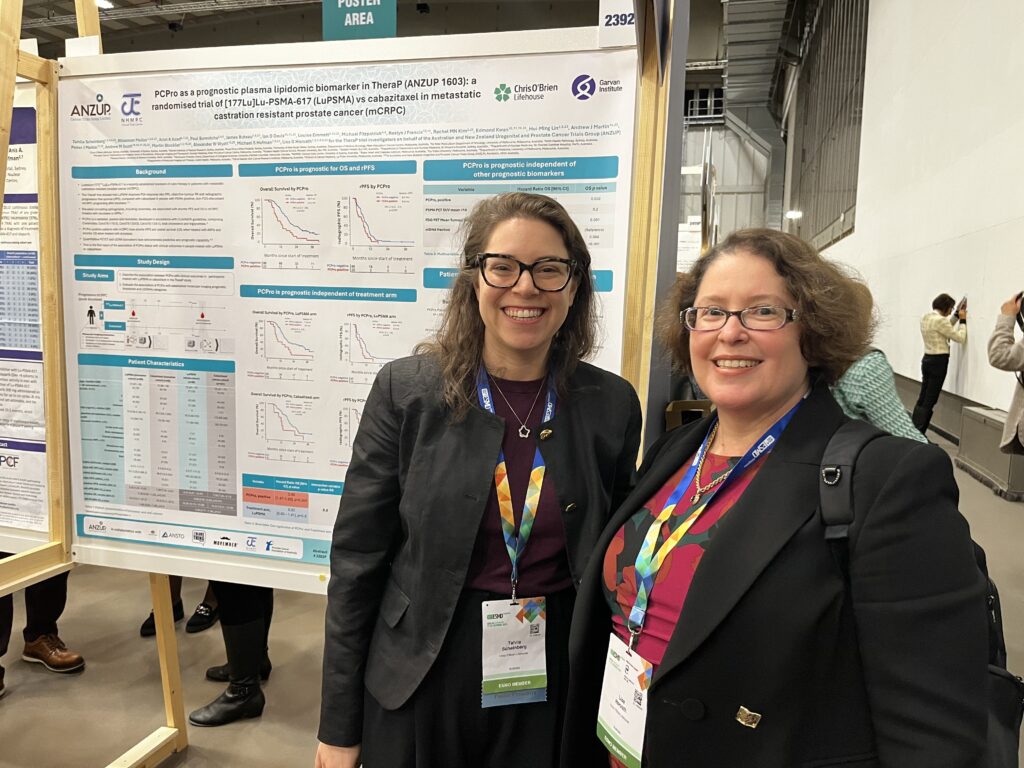
PCPro as a prognostic plasma lipidomic biomarker in TheraP (ANZUP 1603): a randomised trial of [177Lu]Lu-PSMA-617 (LuPSMA) vs cabazitaxel in metastatic castration resistant prostate cancer (mCRPC) – Presented by Tahlia Scheinberg
TheraP showed that LuPSMA improves PSA response rate, objective tumour response rate, and radiographic progression free survival (rPFS), compared with cabazitaxel in participants with PSMA-positive, non-FDG-discordant mCRPC progressing after docetaxel.
In previous studies, the PCPro biomarker has been shown to be prognostic for progression free and overall survival in people with advanced castrate resistant prostate cancer (mCRPC), and predictive of response to androgen receptor pathway inhibitors or docetaxel chemotherapy.
At ESMO, Dr Sheinberg and Prof Lisa Horvath presented results that show for the first time the association of the CLIA/NATA compliant plasma lipid biomarker PCPro assay with the clinical outcomes of patients treated with LuPSMA and cabazitaxel.
In the entire cohort, 22 out of 108 patients were positive for PCPro and this was prognostic of shorter progression free and overall survival, independently of whether patients received LuPSMA or cabazitaxel. These findings suggest that PCPro could be a useful test to help predict outcomes for people receiving LuPSMA or taxane chemotherapy.
References:
- Cancer Data in Australia, Australian Institute of Health and Welfare (AIHW) 2025
- New Zealand Cancer Registry (NZCR), Health New Zealand-Te Whatu Ora
- National Cancer Control Indicators; relative survival for prostate cancer by stage, 2011