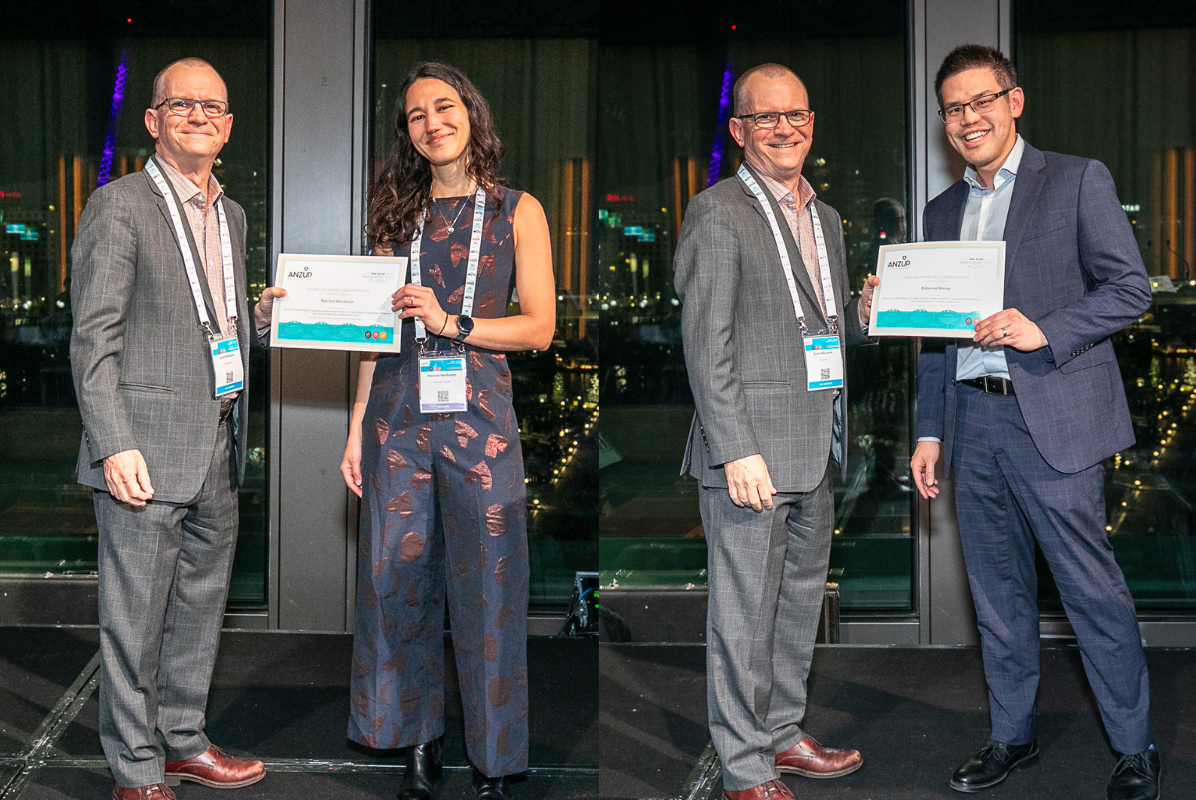
Below the Belt Award
Harriet Herbison and Edmond Kwan — 2025
SPOTLIGHT: Serial Profiling of Oncogenic biomarkers through Treatment in Liquid biopsy for InvestiGating Heterogeneity and Treatment response in metastatic prostate cancer
Despite significant advances in treatment, men with metastatic prostate cancer still face considerable uncertainty. While many benefit from therapies that extend life and ease symptoms, doctors often lack timely indicators to determine if treatment is effective. This can result in patients remaining on ineffective therapies longer than necessary, delaying better options and exposing them to side effects that impact both body and mind.
Our project aims to develop a new blood test, or ‘liquid biopsy’, to monitor how prostate cancers change shortly after treatment begins. Traditional liquid biopsies focus on finding genetic mutations in circulating tumour DNA (ctDNA)—fragments of DNA released into the blood from dying cancer cells. However, genetic mutations only tell part of the story. We aim to push liquid biopsy into uncharted territory by studying how genetic mutations interact with chemical ‘epigenetic’ marks on ctDNA itself—a combined approach never before applied in prostate cancer. These marks act like dimmer switches, influencing whether certain genes in cancer cells are turned on, off, or somewhere in between. Moreover, these marks serve as a molecular fingerprint of the cancer’s identity, predicting how likely it is to respond to treatment.
SPOTLIGHT will reach underserved populations. It is specifically designed to be implemented in remote locations and will partner with ePAD, a nation-wide registry with participating sites in regional and remote locations. We are also committed to engaging diverse communities, and have already collected samples from participants with a broad range of cultural and language backgrounds.
Our ultimate goal is to develop a blood test that provides real-time insights into a cancer’s behaviour. The blood marker developed herein could be used to analyse samples already collected in ANZUP trials, or help design future studies that match treatments to patients based on their cancer biology. These techniques can also be applied to other cancers, such as bladder and kidney cancer, expanding ANZUP’s translational research agenda.
Our project aims to develop a new blood test, or ‘liquid biopsy’, to monitor how prostate cancers change shortly after treatment begins. Traditional liquid biopsies focus on finding genetic mutations in circulating tumour DNA (ctDNA)—fragments of DNA released into the blood from dying cancer cells. However, genetic mutations only tell part of the story. We aim to push liquid biopsy into uncharted territory by studying how genetic mutations interact with chemical ‘epigenetic’ marks on ctDNA itself—a combined approach never before applied in prostate cancer. These marks act like dimmer switches, influencing whether certain genes in cancer cells are turned on, off, or somewhere in between. Moreover, these marks serve as a molecular fingerprint of the cancer’s identity, predicting how likely it is to respond to treatment.
SPOTLIGHT will reach underserved populations. It is specifically designed to be implemented in remote locations and will partner with ePAD, a nation-wide registry with participating sites in regional and remote locations. We are also committed to engaging diverse communities, and have already collected samples from participants with a broad range of cultural and language backgrounds.
Our ultimate goal is to develop a blood test that provides real-time insights into a cancer’s behaviour. The blood marker developed herein could be used to analyse samples already collected in ANZUP trials, or help design future studies that match treatments to patients based on their cancer biology. These techniques can also be applied to other cancers, such as bladder and kidney cancer, expanding ANZUP’s translational research agenda.