
ANZUP at ESMO 2025 – ENZAMET
ENZAMET
Background
Prostate cancer remains the most commonly diagnosed cancer in Australia and New Zealand with over 28,000 cases expected to be recorded in 2025¹,². Thanks to world class research, prostate cancer can be treated effectively for the majority of the people affected. Nevertheless, over 4,000 people every year will die due to an advanced or hard-to-treat form of prostate cancer and many more people will have life-long treatment related side-effects including morbidity associated with long-term hormonal suppression, sexual dysfunction and mental health issues³.
Metastatic castration-resistant prostate cancer (mCRPC) is a type of advanced prostate cancer that has spread to other parts of the body and no longer responds to standard hormone therapy, which is meant to lower testosterone. Even though testosterone levels are low, the cancer keeps growing. While it can’t be cured, there are several treatment options that can help slow the cancer down and manage symptoms.
About the trial
Enzalutamide is a new hormone treatment taken as tablets. Previous trials have proven that enzalutamide improves survival and quality of life in people with prostate cancer that has stopped responding to standard hormone treatments and chemotherapy.
This large, international randomised trial was undertaken to determine if treatment with enzalutamide can improve survival and quality of life in people starting hormone treatment for newly diagnosed prostate cancer that has spread beyond the prostate. The trial was led from Australia by ANZUP in collaboration with the NHMRC Clinical Trials Centre. It involved 1,125 people from Australia, New Zealand, Canada, the US, Ireland, and the UK.
In 2020 the ENZAMET trial won all three of the Australian Clinical Trials Alliance (ACTA) Awards. The ENZAMET trial was awarded the 2020 ACTA Trial of the Year Award, the ACTA STInG Award for Excellence in Trial Statistics and the Consumer Involvement Award.
This landmark Australian led clinical trial, ENZAMET, has now shown that hormone therapy with a drug called enzalutamide can improve the survival of some people with advanced, hormone-sensitive prostate cancer. Findings from the ENZAMET trial, led by ANZUP, have shown that people with this sort of cancer who receive enzalutamide with standard treatment have a 33% improvement in survival compared to people receiving standard treatment alone and a 60% improvement in the time it takes to detect the cancer growing again. These results were much better than it was thought they might be when the trial began.
The ANZUP investigator initiated studies were financially supported by Astellas, who also provided enzalutamide.
Poster presentation at the ESMO 2025
At ESMO 2025, two posters on the ENZAMET study were presented.

#2483P: PCPro, plasma lipid biomarker, in metastatic hormone-sensitive prostate cancer (mHSPC): from research to clinical implementation in the ENZAMET trial (ANZUP 1304) – Presented by Rhiannon Mellor
In previous work, an analysis of ANZUP’s ENZAMET trial samples and data showed that PCPro, a biomarker of baseline plasma lipidomic profiles enriched with sphingolipids such as ceramides and sphingomyelins, is associated with shorter overall survival in participants with mHSPC treated with ADT and enzalutamide or non-steroidal anti-androgen. This analysis used a research-only high-throughput liquid chromatography-mass spectrometry approach.
Here, Dr Rhiannon Mellor and colleagues sought to develop a NATA/CLIA-compliant PCPro assay needed to enable clinical trials of precision lipid metabolic therapies in mHSPC. The findings showed that the NATA/CLIA-compliant PCPro assay performed well and was highly correlated to the research-only assay but was cheaper, faster, and reproducible for PCPro assessment in patients with mHSPC. The test can also be performed in any clinical hospital laboratory. This work advances PCPro into clinical use, paving the way for prospective trials of precision lipid metabolic therapies.
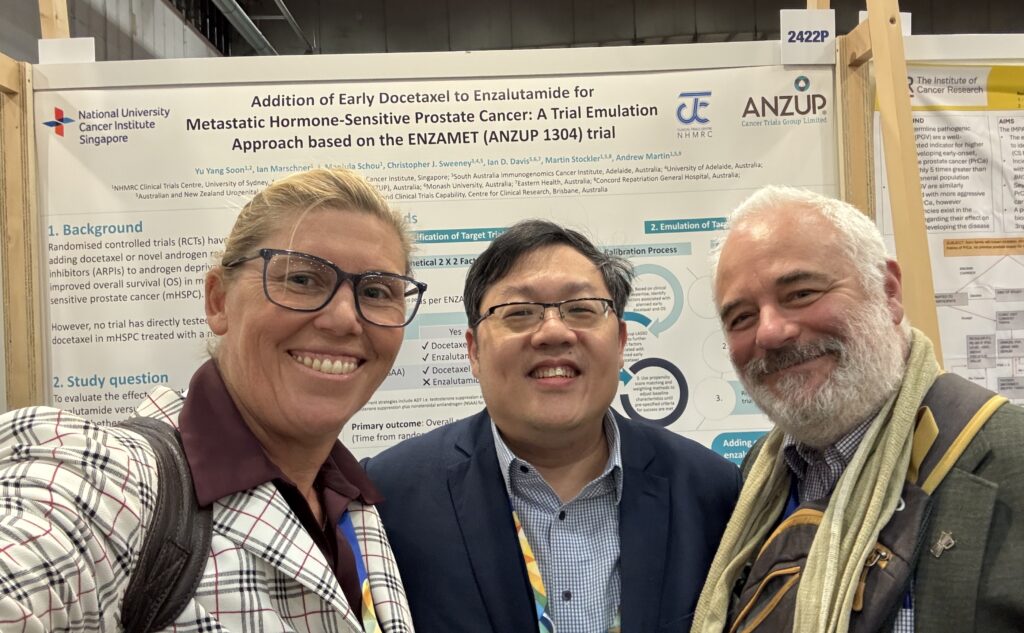
Addition of Early Docetaxel to Enzalutamide for Metastatic Hormone-Sensitive Prostate Cancer: A Trial Emulation Approach based on the ENZAMET (ANZUP 1304) trial – Presented by Yu Yang Soon
The role of early docetaxel is unclear in metastatic hormone-sensitive prostate cancer (mHSPC) being treated with a novel androgen-receptor pathway inhibitors (ARPIs).
Dr Soon aimed to estimate the effects of early docetaxel administration on overall survival in this setting by emulating a randomised clinical trial using the ENZAMET trial dataset which provided information on whether investigators had planned to used early docetaxel administration prior to randomisation.
The results of the trial simulation showed that planned early docetaxel treatment did not alter overall survival in the whole cohort of unselected patients with mHSPC. Planned early docetaxel treatment also did not significantly improve overall survival in participants treated with enzalutamide, independently of tumour volume in this simulation. While these findings do not support routine use of early docetaxel administration with enzalutamide, randomised control trial evidence is needed to clarify the role of early docetaxel in enzalutamide treated mHSPC.
References:
- Cancer Data in Australia, Australian Institute of Health and Welfare (AIHW) 2025
- New Zealand Cancer Registry (NZCR), Health New Zealand-Te Whatu Ora
- National Cancer Control Indicators; relative survival for prostate cancer by stage, 2011