
ANZUP at ASCO 2025 – BCG+MM
BCG+MM
Background
Bladder cancer starts in the bladder, the organ that holds urine, and is a relatively common cancer affecting around 5,000 Australian and New Zealand people every year¹,².
Urothelial cancer is the most common type of bladder cancer that begins in the lining of the urinary tract – and involves the bladder, as well as the tubes that connect the kidneys to the bladder (ureters), and the part of the kidney that collects urine.
While we have seen improvements in the relative survival rate of other cancers thanks to life-improving research, the same is not true for bladder cancer; with only 57% of people affected by bladder cancer expected to meet their five-year milestone. Therefore, new therapeutic strategies for bladder cancer are desperately needed.
About the trial
Non-muscle invasive bladder cancer is common and causes substantial suffering. It requires removal or irradiation of the bladder within five years in more than 30% of people with high-risk tumours, despite best current treatment.
Recent preliminary studies show promising results from adding mitomycin (MM), a chemotherapy drug, to current treatment with BCG (Bacillus Calmette-Guérin, a strain of modified bacteria which stimulates an immune response to early cancer cells). This randomised trial will determine the effects of adding mitomycin on cure rates, survival, side effects and quality of life. This could potentially provide a simple and cost-effective treatment for patients who suffer from this cancer.
ANZUP collaborates with the University of Sydney through the National Health and Medical Research Council Clinical Trials Centre (NHMRC CTC). This ANZUP investigator-initiated study is being funded by Cancer Australia and the National Health and Medical Research Council. We acknowledge Omegapharm and Merck Sharp & Dohme for providing the study drugs.
The BCG+MM trial is now closed to recruitment, and enrolled 501 patients from across Australia and one site in the UK.
Oral presentation at ASCO 2025

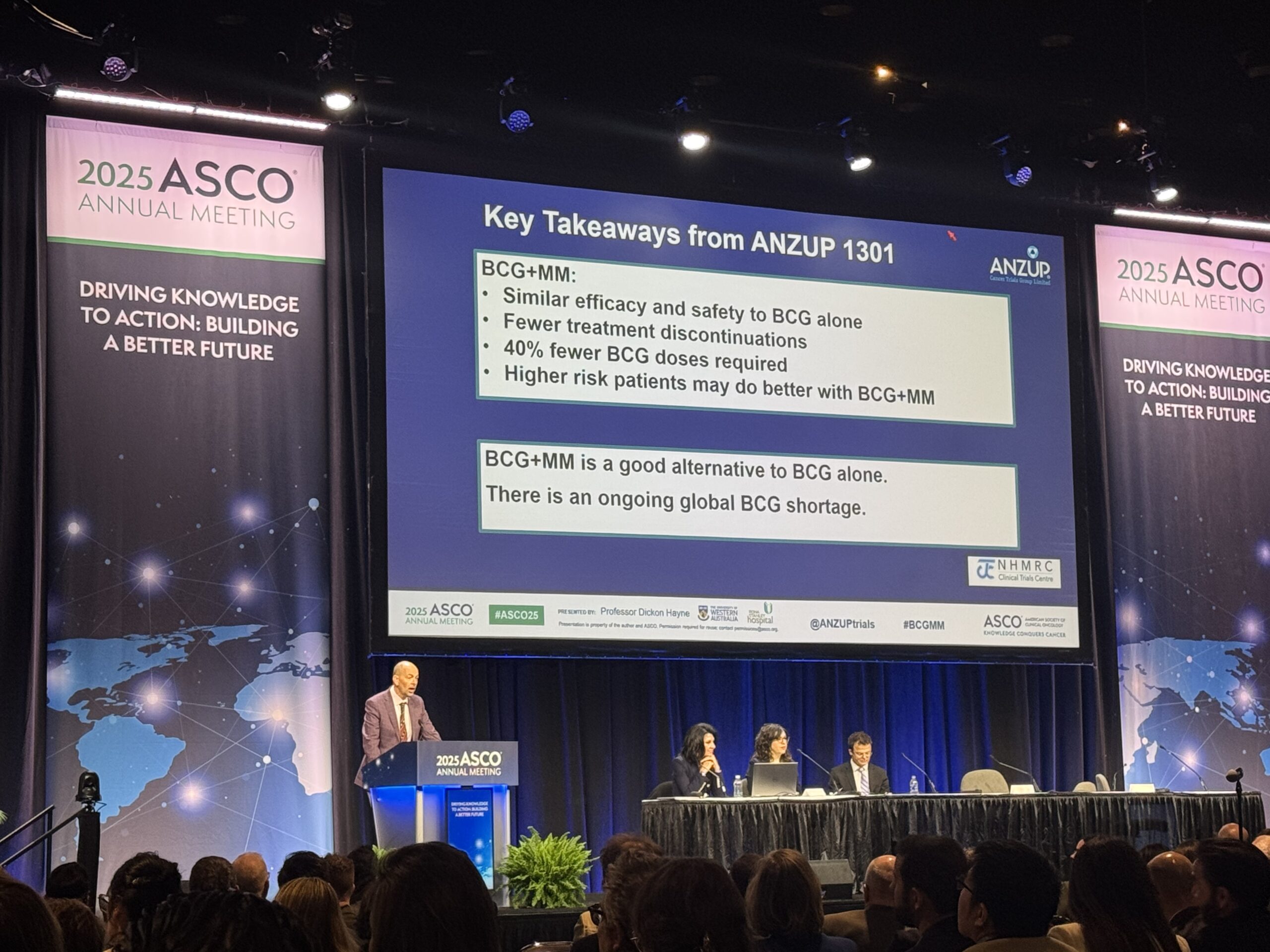
Mitomycin plus (BCG), as adjuvant intravesical therapy for high-risk, non-muscle-invasive bladder cancer: a randomised phase 3 trial (ANZUP 1301)
Prof Dickon Hayne, study chair of the BCG+MM study, presented the overall survival results of the BCG-MM trial that offers hope for people diagnosed with high-risk non-muscle invasive bladder. The findings show that Bacillus Calmette-Guérin or BCG – that works to stimulate the body’s immune system, when used in combination with mitomycin chemotherapy is a safe and effective alternative to BCG alone, with the added benefit of requiring 40 percent fewer BCG doses, and evidence suggests that those at highest risk of recurrence may benefit even more from the combination approach. Patients receiving the combination were more likely continue the treatment course than those on BCG alone. In a time of a global shortage of BCG, the results of this trial could help to expand access to this treatment ensuring more patients get access to the care they deserve.
News story

When Jack Taylor was diagnosed with high-risk bladder cancer at only 20 years old, being told there was a shortage of the potentially life-saving drug he needed was an extra blow.
Now, the BCG+MM study is offering hope, providing an alternative treatment option for bladder cancer patients affected by the immunotherapy shortage.
Read Jack’s story here.
References:
- Cancer Data in Australia, Australian Institute of Health and Welfare (AIHW) 2024
- New Zealand Cancer Registry (NZCR), Health New Zealand-Te Whatu Ora